
 0401 598 986
 admin@activesolarenergy.com.au

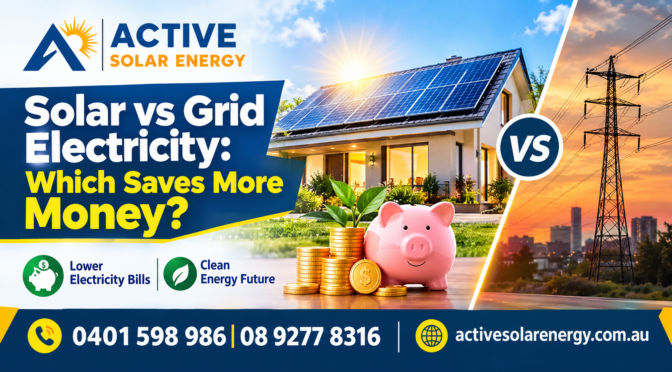
Grid electricity prices keep climbing while solar delivers free power after a short payback. Most Australian households with a quality system cut bills by 1,000–2,000 a year and recover costs in three to six years. Solar panel installation turns rising grid costs into long-term financial control.
How Much Does Grid Electricity Really Cost Right Now?
Australian households typically pay 28–45 cents per kWh for grid power, with annual bills often exceeding 1,300–1,800 depending on state and usage. Prices have risen steadily, and further increases remain likely as network and generation costs climb.
What Are Typical Solar System Costs and Savings in 2026?
A standard 6.6 kW residential solar system costs 4,500–8,000 after the federal STC rebate. Most homes achieve 1,200–2,000 in annual savings through high self-consumption solar savings, with payback periods of three to six years across most states.
| System Size | Typical Cost (After Rebates) | Est. Annual Savings | Common Payback |
| 5 kW | 4,000–6,000 | 1,000–1,400 | 3–5 years |
| 6.6 kW | 4,500–8,000 | 1,200–2,000 | 3–6 years |
| 10 kW | 8,000–10,500 | 2,000–3,000 | 3–5 years |
Why Does Solar Beat the Grid on Long-Term Cost?
Once the system is paid off, solar electricity is essentially free for the remaining 20-plus years of panel life. Every kilowatt-hour you self-consume avoids the full retail rate (often 30–45c), while feed-in tariff rates in Australia now sit at only 3–10c, making self-use far more valuable than exporting.
How Do Feed-in Tariffs and Self-Consumption Compare?
Exporting excess solar earns little in 2026. Using your own power during the day or via solar battery storage in Australia captures the full avoided grid cost and multiplies savings. Maximising daytime usage or adding storage shifts the economics strongly in solar’s favour.
What Role Does a Quality Installer Play in Maximising Returns?
Choosing an experienced Solar installer ensures correct system sizing, quality components and proper orientation so generation matches your actual consumption. Poor design wastes potential and lengthens payback.
Are There Still Strong Government Incentives?
Yes. The federal STC scheme still reduces upfront cost significantly, and some states offer additional support or battery rebates. Acting sooner locks in higher remaining rebate value before the scheme phases down toward 2030.
How Do You Calculate Your Personal Savings Potential?
Review your last 12 months of electricity bills for total kWh and peak usage times. A reputable provider will model expected generation against your load profile, factoring in local grid electricity prices in Australia and available incentives to give a realistic solar payback period in Australia.
Key factors that improve returns:
- High daytime electricity use
- Unshaded north- or west-facing roof
- Larger system matched to consumption
- Optional battery for evening self-use
- Competitive electricity plan with reasonable supply charges
What Should You Look for When Choosing Providers?
Compare multiple quotes from established Solar companies in Australia. Focus on product warranties (25 years on panels is standard), installer accreditation, local service reputation and transparent performance estimates rather than the lowest headline price.
A trusted Best solar company will design around your specific usage rather than pushing oversized systems that export heavily at low feed-in rates. Residential solar installation quality directly affects long-term output and reliability.
Solar power systems deliver the strongest financial outcome when paired with smart energy habits and, where suitable, storage. After payback, the ongoing advantage over pure grid reliance is substantial and compounds as electricity prices continue to rise.
Ready to lock in lower power costs for decades? Speak with a proven Solar energy company like Active Solar Energy today for a free, no-obligation assessment and accurate savings projection tailored to your home. Contact 08 9277 8316 and get clear numbers, compare options and take control of your energy bills before the next price rise hits.
Frequently Asked Questions
Is solar still worth it with low feed-in tariffs?
Yes, because the main savings now come from using your own solar power instead of buying expensive grid electricity.
How long do solar panels last in Australian conditions?
Quality panels typically carry 25-year performance warranties and continue generating well beyond that period.
Do I need a battery to make solar worthwhile?
No, many households achieve strong returns with panels alone, though a battery can increase self-consumption and total savings.
What size system suits a typical three-to-four-person home?
A 6.6 kW system remains the most popular and cost-effective choice for average Australian households.
Can solar eliminate my electricity bill?
It can reduce it dramatically, often to a small supply charge, especially with good self-consumption or battery storage.


