
 0401 598 986
 admin@activesolarenergy.com.au


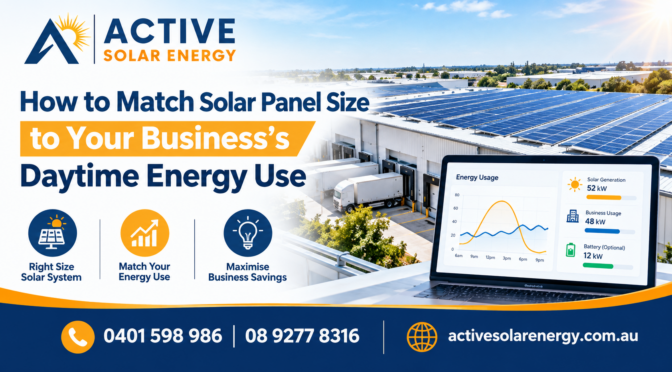
Solar for business only pays off when the system size matches how much power you actually use during daylight hours. Oversize it, and you’re exporting cheap excess to the grid; undersize it, and you’re still paying peak rates.
Here’s how to get the sizing right, step by step.
Why Daytime Energy Use Matters More Than Total Usage
Solar only generates power while the sun’s up, so what counts is your daytime energy consumption, not your total monthly bill. A business running heavy machinery or AC from 9 am to 5 pm gets far more value from commercial solar panels than one that operates mostly after dark.
Step 1: Pull Your Actual Daytime Load Profile
Check your smart meter or retailer portal for interval data broken down by hour, not just the monthly total. Look specifically at usage between 9 am and 4 pm, when solar output peaks, and note your average and peak daytime kW draw over a full billing cycle.
Step 2: Match System Size to Average Daytime Draw
As a rule of thumb, size your system to cover 80-100% of average daytime load rather than your highest peak, since peaks are short-lived and expensive to chase.
| Average Daytime Load | Suggested System Size | Typical Business Type |
| 10-20 kW | 15-30 kW system | Small office, retail shop |
| 20-50 kW | 30-75 kW system | Medium office, warehouse |
| 50-150 kW | 75-200 kW system | Light manufacturing, cold storage |
| 150 kW+ | 200 kW+ system | Heavy manufacturing, large facility |
Office Solar Installation: Sizing for Steady, Predictable Load
Offices typically run a consistent 9-to-5 load, mostly lighting, HVAC and IT equipment. An office solar installation usually sized at 100-120% of average daytime draw covers this reliably without excessive export.
Industrial Solar Installation: Sizing for Variable, High Draw
Factories and processing plants often have irregular spikes from machinery start-ups. For industrial solar installation projects, it’s worth sizing around the average load and pairing it with commercial battery storage to smooth out the spikes instead of oversizing the whole array.
Step 3: Factor In Growth and Seasonal Shifts
A system sized for today’s usage can fall short in two years. Add a 10-20% buffer if you’re expecting business growth, new equipment or extended operating hours, and check whether your usage shifts seasonally (extra AC load in summer, for example).
Do You Need Battery Storage As Well?
Only if you use significant power outside daylight hours or want backup during outages. If your load is almost entirely daytime, a well-sized solar array alone may be enough; otherwise, battery storage for business bridges the gap and improves your overall ROI.
How a Commercial Solar Installer Helps Get Sizing Right
A qualified commercial solar installer will run a proper solar panel sizing calculator against your interval data, shading, roof orientation and future load, which a desktop estimate simply can’t replicate. This step alone can be the difference between a system that pays itself off in 3-4 years and one stuck at 8+.
Quick Checklist Before You Get Quotes
- Pull 12 months of interval (hourly) usage data, not just totals
- Identify your average daytime kW draw, not just peak demand
- Note any planned growth, new equipment or extended hours
- Ask installers for solar energy for business case studies in your industry
- Compare quotes on system size reasoning, not just panel count or price
Ready to Size Your System the Right Way?
Get a free daytime load assessment from Active Solar Energy (replace with your actual business name), Australia’s trusted commercial solar installer for right-sized business solar solutions. Call 0401 598 986 or email admin@activesolarenergy.com.au today to stop overpaying and start generating.
FAQs
Is a bigger solar system always better for my business?
No, oversizing wastes money on excess export credits that pay far less than retail electricity rates.
How long does commercial solar typically take to pay off?
Most well-sized commercial systems in Australia see a solar panel payback period of 3 to 6 years depending on usage and tariffs.
Can I add battery storage later instead of upfront?
Yes, most systems can be designed “battery-ready” so storage can be added once your budget allows.
Does roof space limit my system size?
It can, which is why installers often factor in roof orientation and shading before finalising kW capacity.
What’s the minimum data I need before getting a quote?
At least 12 months of interval usage data gives installers an accurate picture of your true daytime load.


